The Delineator Analytic
Nuances, Sticking With A Signal
A core aspect of our service is to maintain a discipline. We believe the Delineator to be a leading indicator. As such, the price action, after the Delineator generates a signal, may move in the opposite direction of the signal before it moves in a direction that turns the trade profitable. Because of this, there are several possible trading strategies you may wish to consider when using the Delineator. An example of two possible strategies would be:
- When the Delineator generates and confirms a signal, enter the entire
trade.
- When the Delineator generates and confirms a signal, enter 1/3 to 1/2 your position at that time. Should the price action go in the opposite direction of the trade, while the Delineator is moving in the same direction as the signal, look to add to the trade until you reach your full position.
Lets take a look at the following example:
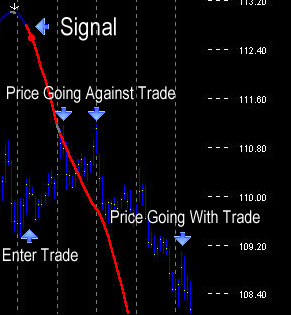
Figure 6-4
In figure 6-4, you see a short signal was generated and confirmed, you enter a short trade. For a full day and a half the price goes against the trade. During this time the Delineator never wavered and continued its downward slope, suggesting you may want to add to the position at a better price then the initial entry price. Shortly thereafter the price followed the direction of the signal and became profitable (from the initial entry point).
Let's take another example:
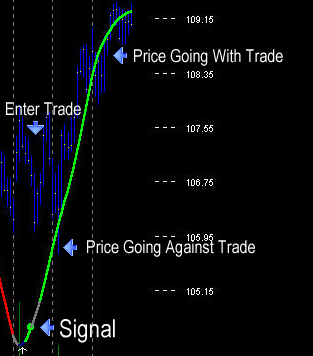
Figure 6-5
In figure 6-5, you see a long signal was generated and confirmed, you enter a long trade. For the next hour the trade goes in the direction of the trade and then reverses and goes against the signal. However, the Delineator never wavered and continued its upward slope. In fact, the Delineator was actually accelerating up during this time. This is the opportunity to add to the position at a better price. Finally the trend reverses again, the price moves in the direction of the signal and the trade becomes profitable (from the initial entry point). Of course not all signals are profitable and in the example above, the Delineator may have given a closing signal and the trade would have lost money.
In the absense of news or some world events that affects trading, counter trend moves, within a signal, are opportunities to increase positions. You may find that you should never trade against the direction of the Delineator.
Once in a trade, it is important to try and not anticipate the Delineators action, taking profits too soon based on traders intuition, but that decision is ultimately yours.
Let's take a look at the following actual example:
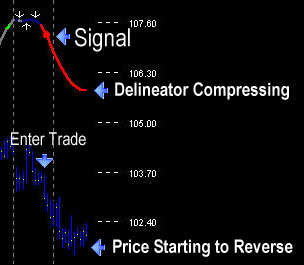
Figure 6-6
In figure 6-6, you have entered into a short trade. The next day it appears as if the delineator is about to generate a positive slope change as it is extremely compressed. The price action also appears as if a reversal is on its way. Because the trade is profitable at this time, the trader is tempted to exit before the Delineator generates a true exit signal. However, things quickly change:
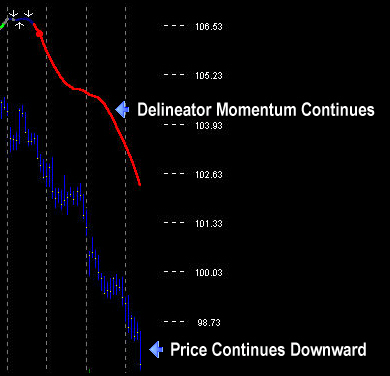
Figure 6-7
In figure 6-7 we see the Delineator again picked up momentum and the price continued its downward trend.
Let's look at were the Delineator actually exited the trade:
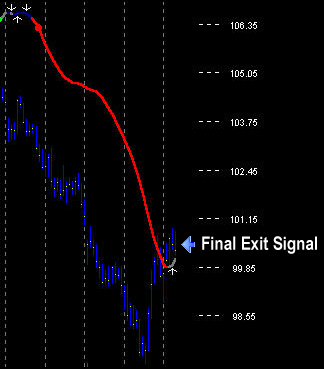
Figure 6-8
In figure 6-8 you can see the Delineator gave back some of the trade before generating a true exit signal. The trade however was more profitable than had it been exited when the Delineator first compressed.
It should be mentioned that staggering exit positions (just as with staggering entry positions) is a possible strategy. For instance, in the example above, when the Delineator was initially compressed and appeared ready to generate a slope change, you may have considered exiting 1/3 to 1/2 the position at that time. This would guarantee a profit on at least a partial amount of the trade, should the indicator and price have actually reversed direction.